Engineering · SAMPLE POST
Understanding it well enough to explain it
A simple structure for turning a technical idea into an explanation someone can follow.
This sample post offers a starting point for your concept explainers. Replace or expand it with a topic from your own learning.
Begin with the problem
Before defining a component or introducing an equation, explain the question it helps answer. What would be difficult without this idea? What is the reader trying to understand?
One concrete example is often enough to give the explanation a purpose.
Build the intuition
Describe the behaviour in ordinary language. A sketch or an analogy can help, but explain where the analogy stops being useful. The goal is a starting point for understanding, not a substitute for the actual model.
Add just enough detail
Introduce the technical terms after the reader has something to attach them to. If you use an equation, define each symbol and its units. State the assumptions, then walk through one example.
Check the explanation
Ask whether a reader could now explain what changes when one input changes. If not, another concrete example may be more useful than another paragraph of definitions.
End with a short exercise or a question to explore. Link to the original sources so readers can go deeper and check the details.
A small worked example
Here is how a simple explanation can combine prose, a diagram, and mathematics. For an ideal resistor, Ohm’s law relates the voltage across it to the current through it:
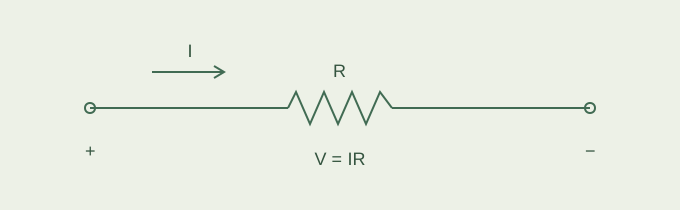
If and , then:
The units are part of the explanation, not an afterthought.1
| Symbol | Meaning | SI unit |
|---|---|---|
| Voltage across the resistor | Volt (V) | |
| Current through the resistor | Ampere (A) | |
| Resistance | Ohm () |
Make the calculation reproducible
A short code example gives the reader something to change and explore:
voltage_v = 3.3
resistance_ohm = 1_000
current_a = voltage_v / resistance_ohm

print(f"Current: {current_a * 1_000:.1f} mA")
# Current: 3.3 mA
Try doubling the resistance while keeping the voltage fixed. The current halves. State the boundary of the model too: this example assumes an ideal resistor with constant resistance.
Footnotes
-
The calculation uses volts and ohms, so its result is in amperes. Multiplying by 1,000 converts amperes to milliamperes. ↩